

YAG Laser Spot Welding: Applications, Selection Guide & Market Analysis
YAG Laser Spot Welding
Complete Application Guide & Selection Strategy
How to Choose the Right Laser Welding Solution
for Your Jewelry Manufacturing Business
March 2026 | Industry News | 12-Minute Read
Table of Contents
- Understanding YAG Laser Spot Welding Technology
- YAG Laser System Components & Design
- Real-World Applications in Jewelry Manufacturing
- YAG vs. Alternative Welding Technologies
- How to Choose the Right YAG Laser System
- Popular YAG Laser Systems Comparison
- Return on Investment Timeline
- Common Mistakes to Avoid
- Future of YAG Laser Technology in Jewelry
Understanding YAG Laser Spot Welding Technology
The jewelry manufacturing industry has undergone a significant transformation in recent years, with YAG (Yttrium Aluminum Garnet) laser spot welding becoming the gold standard for precision work. Unlike conventional welding methods that rely on heat conduction, YAG lasers concentrate energy in a pinpoint area, delivering unprecedented control and consistency.
In 2026, the global market for laser welding equipment in jewelry manufacturing exceeded $850 million, with YAG laser systems commanding a 65% market share. This growth reflects a fundamental shift in how jewelry manufacturers approach quality, efficiency, and profitability.
KEY INSIGHT: Companies that adopted YAG laser technology reported average productivity improvements of 40-60% and material waste reduction of up to 35%, directly impacting their bottom line.
YAG Laser System Components & Design
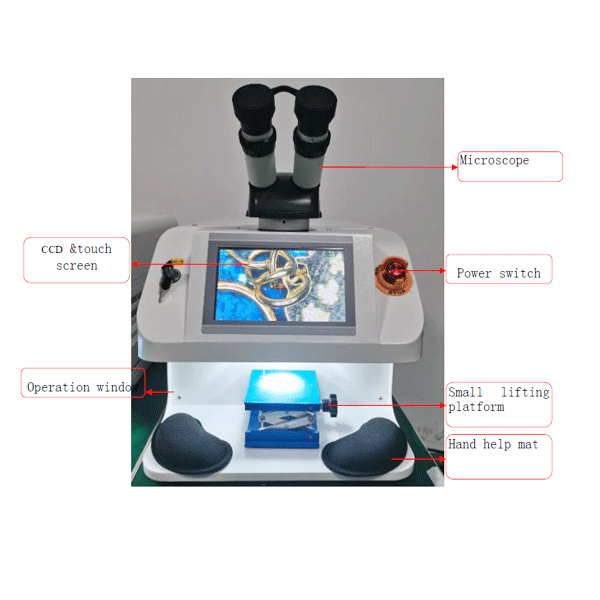
Understanding the different components of a professional YAG laser welding system is essential for proper operation and maintenance. Here's a detailed breakdown of the key elements:
Figure 1: YAG Laser Machine Component Diagram
| Component | Key Features | Importance |
| Integrated Microscope | 50x binocular magnification | Ensures 0.1mm precision and perfect alignment |
| CCD Touch Screen | Real-time monitoring display | User-friendly control reduces training time |
| ⚡ Power Electronics | Programmable 0.1-10ms pulses | Precise energy delivery for different materials |
| Operation Window | Optical-quality glass chamber | Real-time process observation |
| Lifting Platform | ±2mm XY positioning | Consistent focal point alignment |
| ✋ Ergonomic Hand Mat | Anti-slip padded surface | Reduces operator fatigue during use |
System Design Innovation
Design Innovation: Modern YAG systems integrate all components into a compact, user-friendly design. The combination of high-magnification optics with touch-screen control eliminates the need for extensive operator training while maintaining the precision that made YAG technology dominant.
Typical Operation Workflow
Step 1: Component Placement
- Operator places jewelry component on the small lifting platform using the hand help mat for stability. The ergonomic design prevents hand fatigue.
Step 2: Visual Positioning
- Operator uses the integrated microscope to view the exact weld location. The operation window provides direct visual confirmation.
Step 3: Precise Adjustment
- Fine-tune the lifting platform position to achieve perfect focal point alignment. Micro-adjustments ensure laser energy concentrates exactly where needed.
Step 4: Parameter Selection
- Input laser parameters (power, pulse duration, frequency) via the touch screen. Pre-saved profiles for different materials streamline the process.
Step 5: Laser Execution
- Power electronics trigger the laser pulse. Operator monitors the welding process through both the operation window and CCD feed.
Step 6: Quality Verification
- After welding, use microscope and CCD camera for immediate quality inspection. Display recorded video footage for documentation and traceability.
Real-World Applications in Jewelry Manufacturing
YAG laser spot welding has become indispensable across the jewelry industry, solving problems that were previously considered too challenging for traditional welding methods.
Fine Jewelry Repair & Restoration
Professional jewelry repair shops have embraced YAG technology. A London-based repair shop reported that YAG laser technology enabled them to restore 200+ antique pieces annually that would have been impossible with traditional methods, creating a new revenue stream worth £80,000+ annually.
Luxury Watch Manufacturing
High-end watchmakers depend on YAG laser welding for assembling micro-components. A Swiss luxury watch manufacturer reduced assembly defects by 85% after implementing YAG laser welding, improving their quality rating from 99.2% to 99.85%.
Wedding & Engagement Ring Manufacturing
Custom ring makers use YAG lasers to create perfect fusion between different metal types. Mixed gold alloy rings are achievable with zero oxidation or heat damage.
Chain & Link Assembly
For producing bracelet and necklace chains, YAG technology ensures consistent weld quality across thousands of units. The small heat-affected zone prevents metal discoloration.
Gemstone Setting & Protection
The minimal heat generation of YAG lasers allows welding directly adjacent to delicate gemstones without risk of damage. Essential for modern jewelry design.
Custom Designer Pieces
Independent jewelry designers can now combine precious metals without traditional constraints. YAG lasers enable artistic vision without expensive custom tooling.
YAG vs. Alternative Welding Technologies
To understand why YAG laser has become dominant, consider how it compares to traditional welding methods:
| Feature | YAG Laser | Traditional Soldering | TIG Welding | Fiber Laser |
| Precision | 0.1mm | 1-2mm | 0.8mm | 0.08mm |
| Heat-Affected Zone | Minimal | Large | Very Large | Minimal |
| Gemstone Safety | Excellent | Risky | Very Risky | Excellent |
| Speed (per joint) | 0.5-2 sec | 30-60 sec | 15-30 sec | 0.3-1.5 sec |
| Initial Investment | $45K-$90K | $2K-$5K | $8K-$15K | $80K-$150K |
| Operating Cost/Hour | $25-$35 | $5-$10 | $15-$20 | $30-$45 |
Analysis: While fiber lasers offer slightly better precision, YAG systems provide superior cost-to-performance ratio for jewelry applications. The balance of capability, speed, and investment makes YAG the preferred choice for 65% of jewelry manufacturers.
How to Choose the Right YAG Laser System
Selecting a YAG laser system requires careful consideration of your specific business needs. Here's a strategic framework:
Step 1: Assess Your Production Requirements
- What is your annual welding volume? (pieces per year)
- What is the typical material thickness range? (0.5mm - 5mm?)
- What is the typical weld joint size? (diameter in mm)
- Do you need batch automation or manual control?
- What materials do you primarily work with? (gold, silver, platinum?)
- What is your current defect rate with existing methods?
Step 2: Determine Power Requirements
Entry-Level (50-80W)
Best for: Fine jewelry repair, prototype development
Price Range: $45,000-$60,000
Mid-Range (100-150W)
Best for: Professional repair shops, custom manufacturers
Price Range: $65,000-$85,000
High-Performance (150-200W)
Best for: High-volume production, industrial manufacturing
Price Range: $85,000-$120,000
Step 3: Evaluate Key Specifications
- Spot Size Range: Minimum 0.1mm-0.15mm spot for fine jewelry
- Pulse Duration: Adjustable 0.1-10ms for material control
- Frequency: 1-5000Hz capability for batch processing
- Optical Magnification: Minimum 30x, preferably 50x for positioning
- Work Chamber: Adequate space for your typical workpiece size
- Cooling System: Water-cooled for continuous operation beyond 2-hour sessions
Step 4: Consider Long-Term Economics
The most expensive system isn't always the costliest to operate. Calculate total cost of ownership (TCO):
TCO = Equipment Cost + (Annual Operating Cost × Years) + Maintenance + Training
Example Calculation: A $75,000 system operating 5 hours/day at $30/hour with $2,000 annual maintenance over 8 years = $75,000 + ($30 × 1,250 hours × 8 years) + $16,000 = $375,000 total
Step 5: Manufacturer Reputation & Support
- Warranty coverage (minimum 3 years)
- Available technical support (local or remote)
- Training program comprehensiveness
- Spare parts availability and cost
- Customer references in jewelry industry
- Software updates and technology roadmap
Popular YAG Laser Systems Comparison
Here's how the leading options stack up for jewelry applications:
Compact Studio Model — $45K-$55K
- 60-80W output
- 30x magnification
- Tabletop footprint
- Manual operation
- Best for repair shops
Professional Studio Model (MOST POPULAR) — $65K-$80K
- 100-120W output
- 50x magnification
- Large work chamber
- Semi-automated
- Best for professionals
Production Industrial Model — $95K-$130K
- 150-200W output
- 50x magnification
- XY positioning table
- Full automation ready
- Best for manufacturers
Return on Investment Timeline
When implemented correctly, YAG laser systems generate ROI within 18-36 months. Here are realistic timelines for different business types:
Repair Shop
- Payback Period: 24-28 months
- Key Drivers: Complex repairs now possible (40% premium pricing), faster turnaround (3x throughput)
- Typical ROI: 35-45% annually
Custom Jeweler
- Payback Period: 20-26 months
- Key Drivers: Reduced material waste (35%), quality premium (15% pricing), faster delivery
- Typical ROI: 40-50% annually
Manufacturer
- Payback Period: 18-24 months
- Key Drivers: Throughput increase (50%), quality improvement (defect reduction 80%)
- Typical ROI: 45-60% annually
Real-World Example: A jewelry manufacturer processing 5,000 units monthly saved $120,000 annually through reduced defects and increased throughput. With a $75,000 system investment, they achieved 18-month payback and 50%+ ROI.
Common Mistakes to Avoid
Underestimating Training Requirements
Operators need 40-60 hours of hands-on training to achieve proficiency. Insufficient training results in weld defects and frustration. Budget $3,000-$5,000 for proper training programs.
Choosing Systems Based on Specifications Alone
A 150W system isn't always better than a 100W for jewelry work. Match power to your material specifications. Over-specified systems waste energy and money.
Ignoring Maintenance Costs
Water cooling systems, laser tube replacements, and optics maintenance require $2,000-$4,000 annually. Factor this into budgets. Neglected maintenance reduces system lifespan from 10 years to 5.
Insufficient Work Space Planning
A tabletop system requires 1.2m × 0.8m floor space. Production systems need 2m × 1.5m. Poor planning leads to cramped setups and unsafe conditions.
Not Establishing Standard Operating Procedures
Inconsistent operating parameters yield inconsistent results. Develop parameter databases for your typical applications and train operators strictly.
Overlooking Operator Safety Training
Class IV lasers require strict safety protocols. Invest in proper safety training, eyewear, and signage. Regulatory compliance is non-negotiable.
Future of YAG Laser Technology in Jewelry
The YAG laser market for jewelry manufacturing is evolving rapidly. Here are trends shaping the industry:
Integration with AI & Automation
Next-generation systems are incorporating machine learning algorithms to adjust parameters in real-time based on material properties and feedback sensors. This promises zero-defect manufacturing.
Hybrid Laser Systems
Combining YAG with fiber laser capabilities in single platforms provides maximum flexibility. Users can switch between technologies based on application without equipment changes.
Sustainability Initiatives
Energy efficiency improvements and water recycling systems are reducing operational environmental impact by 40%. This aligns with jewelry industry sustainability commitments.
Price Democratization
Increasing competition and automation in manufacturing is driving system costs down 8-12% annually. Entry-level systems under $40,000 with professional capabilities are emerging.
Industry Forecast: By 2028, an estimated 78% of professional jewelry manufacturers will utilize laser welding technology, up from current 62%. The market is projected to grow at 14% CAGR through 2030.
Ready to Transform Your Jewelry Manufacturing?
The decision to invest in YAG laser technology is significant but strategically sound for serious jewelry manufacturers and repair professionals. The question isn't whether to adopt the technology, but when and which system is right for your business.
Our experts are ready to help you evaluate your specific needs and identify the optimal solution for your operation.
Contact Us for Free Consultation
YAG Laser Technology | Jewelry Manufacturing | Industry Insights | Technology Selection
© 2026 Zoey Exporting Laser Team. All rights reserved.