


Fiber Laser vs CO2 Laser Marking Machine: Which One Do You Need?
Quick answer: it depends on what you mark
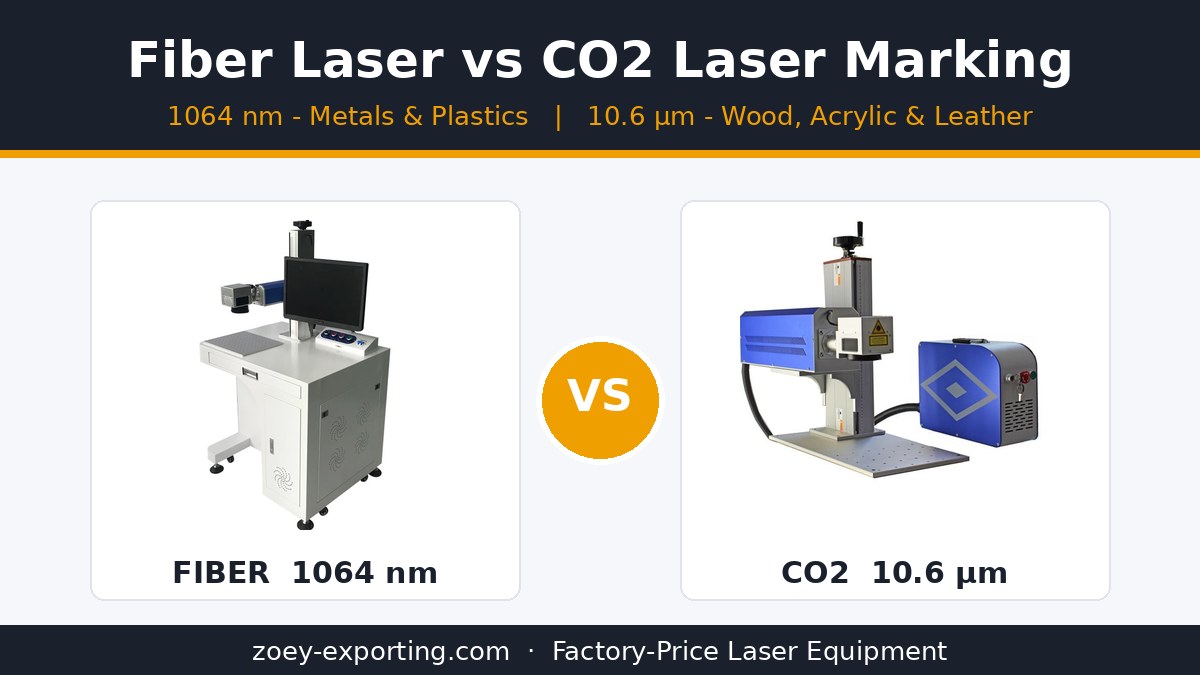
If your parts are metal — stainless steel, aluminum, brass, titanium, coated steel — buy a fiber laser marking machine. If you mark wood, acrylic, leather, glass, ceramics, rubber or coated paper, buy a CO2 laser. A single machine cannot do both well, so the decision usually comes down to which material represents most of your revenue.
| Your main material | Choose | Why |
|---|---|---|
| Stainless steel, aluminum, brass, titanium | Fiber (1064 nm) | Metals absorb 1064 nm strongly; CO2 light bounces off |
| Anodized aluminum, painted or powder-coated metal | Fiber | Removes the coating cleanly without cutting into the base |
| Wood, MDF, plywood, paper, cardboard | CO2 (10.6 µm) | Organics absorb 10.6 µm; fiber barely leaves a mark |
| Acrylic, clear or colored | CO2 | Produces frosted or deeply engraved marks |
| Leather, fabric, rubber | CO2 | Clean surface mark with minimal edge burn when focused |
| Glass, ceramics, stone | CO2 | Micro-crack frosting effect that stays legible |
| ABS, PC, PE and most engineering plastics | Fiber | High contrast at low heat input, no melting |
| Deep engraving into steel beyond 0.3 mm | Fiber (30 W or higher) | Higher peak power density removes more material per pass |
How the two technologies actually differ
Both machines steer a focused beam with a galvanometer scanner and both are "marking" systems rather than cutting tables. The difference that matters is wavelength, because wavelength decides which materials absorb the energy instead of reflecting it.
Fiber laser marking: 1064 nm, built for metal
A fiber laser uses an ytterbium-doped active fiber to produce 1064 nm infrared light. Steel, aluminum, brass, titanium, copper alloys and most engineering plastics absorb this wavelength efficiently, so the energy goes into the surface instead of bouncing back into the optics. The beam can be focused to roughly 20–50 µm, which is why fiber markers hold fine detail on small parts such as surgical instruments, bearings, tool holders and nameplates.
On stainless steel and some tool steels, a fiber laser can also produce annealing marks: the surface oxidizes into a dark, high-contrast layer without removing material. That matters for food-contact and medical parts, where an engraved groove can trap residue and fail inspection. Marking depth is typically 10–50 µm for surface marks and up to 0.5 mm for deep engraving with a 30–50 W source.
CO2 laser marking: 10.6 µm, built for everything else
A CO2 laser generates far-infrared light at 10.6 µm. Organic materials — wood, paper, leather, acrylic, most fabrics — absorb this wavelength very strongly, while bare metals reflect almost all of it. That is why a CO2 marker on untreated stainless steel produces a faint, low-contrast line unless you apply a marking compound or coating first.
On the materials it is designed for, the CO2 laser is fast, cheap to run and visually superior. It creates a frosted, engraved or charred mark depending on power and speed, and it handles curved or irregular surfaces well when paired with a rotary axis.
Mark quality, depth and durability
Fiber marks on metal usually survive salt spray, abrasion and solvent wiping because the mark is either oxidized into the surface or engraved below it. CO2 marks on wood and leather are surface-level and can fade under heavy abrasion, while CO2 marks on glass and ceramics are permanent but brittle — a deep scribe can initiate a crack.
Contrast is the other practical difference. A 20 W fiber laser produces a near-black mark on stainless steel with a single pass. A CO2 laser needs either a coating or a much higher power density to reach comparable contrast on metal, and even then the mark is often grey rather than black.
Speed and throughput
Scanning speed itself is similar — both systems run galvo heads at several thousand millimeters per second — but the effective throughput is not, because each material needs a different energy dose.
| Task | Fiber 20–30 W | CO2 60–80 W |
|---|---|---|
| Logo on stainless steel, 20 × 20 mm | 1–3 s | 8–20 s (needs coating) |
| Data matrix code on aluminum | 0.5–1.5 s | Not practical |
| Serial number on acrylic | Grey, low contrast | 2–4 s, frosted white |
| Logo on leather patch | Burns unevenly | 2–5 s, clean |
| Deep engraving, 0.2 mm into steel | 15–40 s | Not practical |
For production lines, fiber markers are usually paired with a conveyor and a flying-marking function so parts are marked in motion. CO2 systems are more often used in batch mode, where a jig holds a tray of parts.
Cost: purchase price and cost per mark
At equivalent build quality, a fiber marking machine costs more than a CO2 unit of similar power, but the gap has narrowed sharply in the 20–30 W range that most workshops actually need.
| Item | Fiber 20–30 W | CO2 60–80 W |
|---|---|---|
| Typical unit price (China, FOB) | USD 2,800–6,500 | USD 2,200–5,000 |
| Consumables | None for the source; lens and protective window only | Laser tube every 2,000–4,000 h |
| Source lifetime | 80,000–100,000 h | Tube replacement USD 300–900 |
| Power draw | 0.5–1.2 kW | 1–2.5 kW (chiller included) |
| Cooling | Air cooled on 20–30 W | Water chiller required |
Running cost is where the fiber machine pulls ahead. With no tube to replace and lower power draw, the cost per mark on metal is dominated by the initial purchase. The CO2 tube is a real recurring cost, and a workshop marking eight hours a day should budget for a replacement roughly every twelve to eighteen months.
When a fiber laser is the right choice
- Metal is the main substrate. Anything from stainless cookware to bearing rings to aluminum housings.
- You need permanent traceability. Data matrix codes, VIN plates, UDI marks on medical devices, tool serial numbers.
- Marks must pass inspection. Annealing marks leave no groove, which matters for food-contact and implantable parts.
- You want minimal maintenance. No tube, no chiller on low-power models, no marking compound.
- You mark small parts at high density. Jewelry, electronics hardware, fasteners, surgical tools.
When a CO2 laser is the right choice
- You work with wood, acrylic, leather or glass. This is where CO2 quality is simply better and faster.
- You need cutting and marking on one machine. A CO2 gantry handles both on non-metals.
- You produce signage, awards, packaging or personalized gifts. Frosted acrylic and deep wood engraving are CO2 work.
- Budget is tight and metal is only occasional. If 90% of your output is wood or acrylic, a CO2 machine earns its keep faster.
Five questions to settle before you order
- What percentage of your parts are metal? Above roughly 70%, fiber is almost always the right call.
- Do you need depth or just contrast? Contrast only → 20 W fiber is enough. Depth beyond 0.3 mm → step up to 30–50 W.
- What is the smallest feature you must resolve? Below 0.2 mm text, check the spot size and the lens focal length, not just wattage.
- Will parts be marked in motion? If yes, you need flying-marking firmware and a conveyor interface.
- What is your service access like? Ask for the source brand (Raycus, JPT, IPG), the warranty length and whether spare lenses ship from stock.
Frequently asked questions
Q1: Can a fiber laser mark wood or acrylic?
A1: It can leave a shallow brown or grey burn, but the contrast is poor and inconsistent across grain or color. For wood, acrylic, leather or glass a CO2 laser produces a far cleaner and faster result, so fiber is the wrong tool for those materials even though the beam technically interacts with them.
Q2: Can a CO2 laser mark stainless steel?
A2: Only with a marking compound or coating applied first, and the mark is usually grey rather than black. Bare stainless steel reflects most 10.6 µm energy, so a CO2 laser is not a practical choice for permanent metal traceability marks.
Q3: Which machine is faster?
A3: On metal, a 20–30 W fiber laser is typically five to ten times faster than a CO2 unit because the material absorbs the energy instead of reflecting it. On wood, acrylic or leather, the two are comparable and CO2 often wins on mark quality.
Q4: How much does each type cost?
A4: A 20–30 W fiber marking machine typically runs USD 2,800–6,500 FOB China, while a 60–80 W CO2 unit runs USD 2,200–5,000. Add 15–25% for rotary axes, enclosed cabinets or CCD camera positioning. Running cost favors fiber because there is no tube to replace.
Q5: Do I need a rotary attachment?
A5: If you mark rings, tubes, shafts, bottles or any cylindrical part, yes. A rotary axis keeps the focal distance constant as the part turns, which prevents the mark from going out of focus and losing contrast along the curve. Budget roughly USD 200–600 depending on the chuck type.
Next step
If you are still unsure, send us the material, the part size and a photo of the mark you need to reproduce. We will tell you which wavelength fits and quote the closest model from stock — no obligation.
- Browse fiber laser marking machines (20W–100W)
- Browse CO2 laser marking machines (30W–100W)
- Popular models: 20W fiber marker, 50W fiber marker, 30W CO2 marker, mini 60W CO2 marker

